Almost every collections platform in the market now calls itself AI-powered. However, very few of them are completely agentic. That distinction is not a technicality. It decides whether a platform can smartly run the collections for a portfolio on its own or whether it still needs a human to make every decision it surfaces.
Collections Heads and CROs are being pitched “agentic AI” in almost every vendor conversation this year. Most of what gets pitched under that name is a chatbot or a voicebot with a better script and controls, or a dialer with a recommendation engine bolted on. Neither is truly agentic. Here is the actual definition, why it matters for a 60 million account book, and how to tell the difference before you sign a contract.
A voicebot, however well built, waits. It answers a question, follows a decision tree, or reads out a script, and then it stops and waits for the next instruction, from a customer or from an operator.
An agent does not wait. It reasons over a customer’s full context: credit history, past disputes, sentiment from the last conversation, propensity to pay, and channel preference. It chooses the next best action from a governed policy set. It executes that action: a call, a WhatsApp nudge, a scheduled callback, or a clean handoff to a human agent or a legal workflow when judgment is required. Then it moves to the next account, and the next, across the entire portfolio, continuously.
That is the whole distinction. A chatbot or voicebot responds to what is put in front of it. An agent decides what happens next and makes it happen without an operator in the loop for every step.
Collections run on scale and speed at once. A mid-sized lender does not have sixty accounts that need attention today. It has sixty thousand, spread across different buckets that shift by the day as bounces post and payments land. A human team, however well staffed, reviews a part of that book on any given day and acts on what it manages to review.
An agentic system does not review a part. It reasons over every account, every day, and acts on what it finds, at the speed the book actually moves. That is not a productivity improvement on top of the existing process. It is a different process.
Most platforms marketed as agentic are missing at least two or three of the following. All five have to be true at once, or the word does not apply.
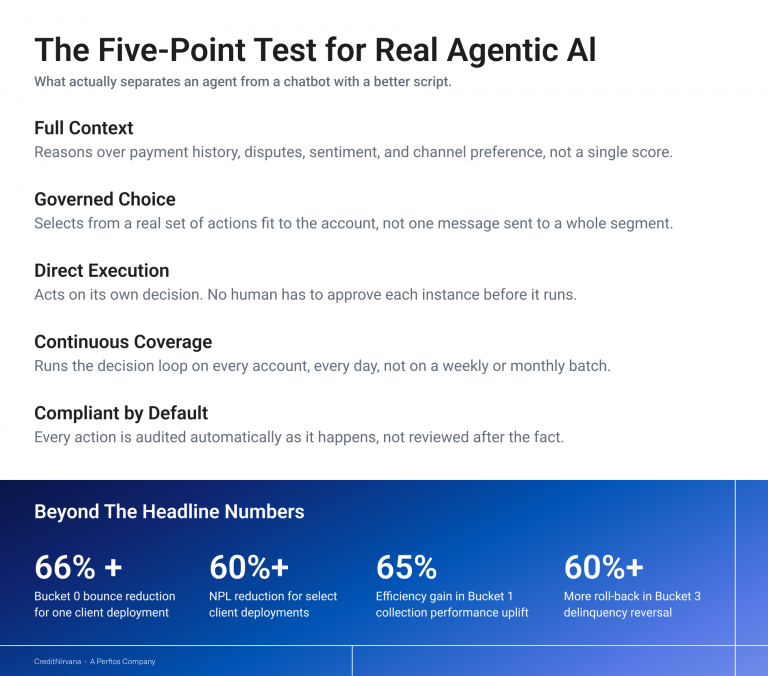
It reasons over full context, not a single data point. True reasoning goes beyond a standalone propensity score. It requires a unified decision-making engine that synthesizes payment history, ongoing disputes, customer sentiment, preferred channels, and optimal timing models.
It chooses from a governed policy set, not a fixed script. The action taken has to be one of several available options, selected because it fits this account, not the same message sent to every account in a segment. The policy set can be a complex set of rules allowing flexibility for human overrides.
It executes the action itself. A recommendation surfaced to a human, who then decides whether to act on it, is not agentic. It is a better dashboard. Execution has to happen without a human approving every instance however human overseeing the excution and providing necessary intervention as and when needed
It runs continuously across the full portfolio everyda; however, humans oversee A monthly or weekly batch process that flags accounts for attention is not agentic, no matter how sophisticated the flagging logic. Agentic means the decision loop runs constantly, account by account, as new signal arrives.
Every action is compliant and audited by default, not by exception. In a regulated industry, autonomous execution without a full audit trail is not a feature gap. It is a reason not to deploy the system at all.
Platforms requiring human input for decisions are merely decision-support tools, while those following fixed scripts without context are simply automation tools. Both are useful, but neither qualifies as truly agentic.
Maestro, CreditNirvana’s agentic AI collection engine, is built around all five of those conditions, not around one of them dressed up as the whole story.
It runs 200-plus purpose-built GenAI collection agents, covering the full collection curve from pre-due reminders through overdue outreach to settlement negotiation. Each agent reads intent and sentiment in real time, detects disputes as they surface in conversation, and chooses the next action from a live, governed policy set: a call, a WhatsApp nudge, a scheduled callback, or an escalation to a human agent or legal workflow. Every one of those actions runs inside a compliance-checked, fully audited process, with a full run log behind every decision an agent makes.
That is orchestration, not a single bot answering questions faster. One engine coordinates the entire agent bank continuously, and it is built with the governance a regulated system needs from the start: consent capture, DND and DLT screening, call time windows, and immutable audit trails with full version history, enforced automatically rather than reviewed after the fact.
The result shows up in the numbers, not in the pitch. These are measured outcomes from CreditNirvana deployments across Indian banks, NBFCs, and fintechs, not projections: bounce rates down to 20% within three to six months, non-performing loans down to 15% within six to nine months, and collection operating costs down 30% in the same window. That is what happens when a system actually reasons, decides, and acts across a whole portfolio, instead of surfacing suggestions for a human to act on one account at a time.
Before a collections head or CRO signs off on a platform marketed as agentic, five questions settle the claim quickly.
Does it reason over full customer context or a single score? Does it choose from a real set of actions or send the same message to everyone in a segment? Does it execute directly, or does a human still have to approve each action first? Does it run continuously across the book or on a batch cycle? And is every action compliant and audited automatically, with nothing left to a manual review step?
If the answer to any of those is no, the platform is not agentic. It may still be a good tool. It should just not be bought as something it isn’t.
The word “agentic” is doing a lot of work in collections marketing this year. It should be doing that work because the system earns it, not because the term tests well in a sales deck. Every receivable, resolved, starts with knowing exactly what kind of system is actually doing the resolving.
©2022.CreditNirvana. All Rights Reserved.